
The Blunt Instrument
Precision Medicine, Part 1

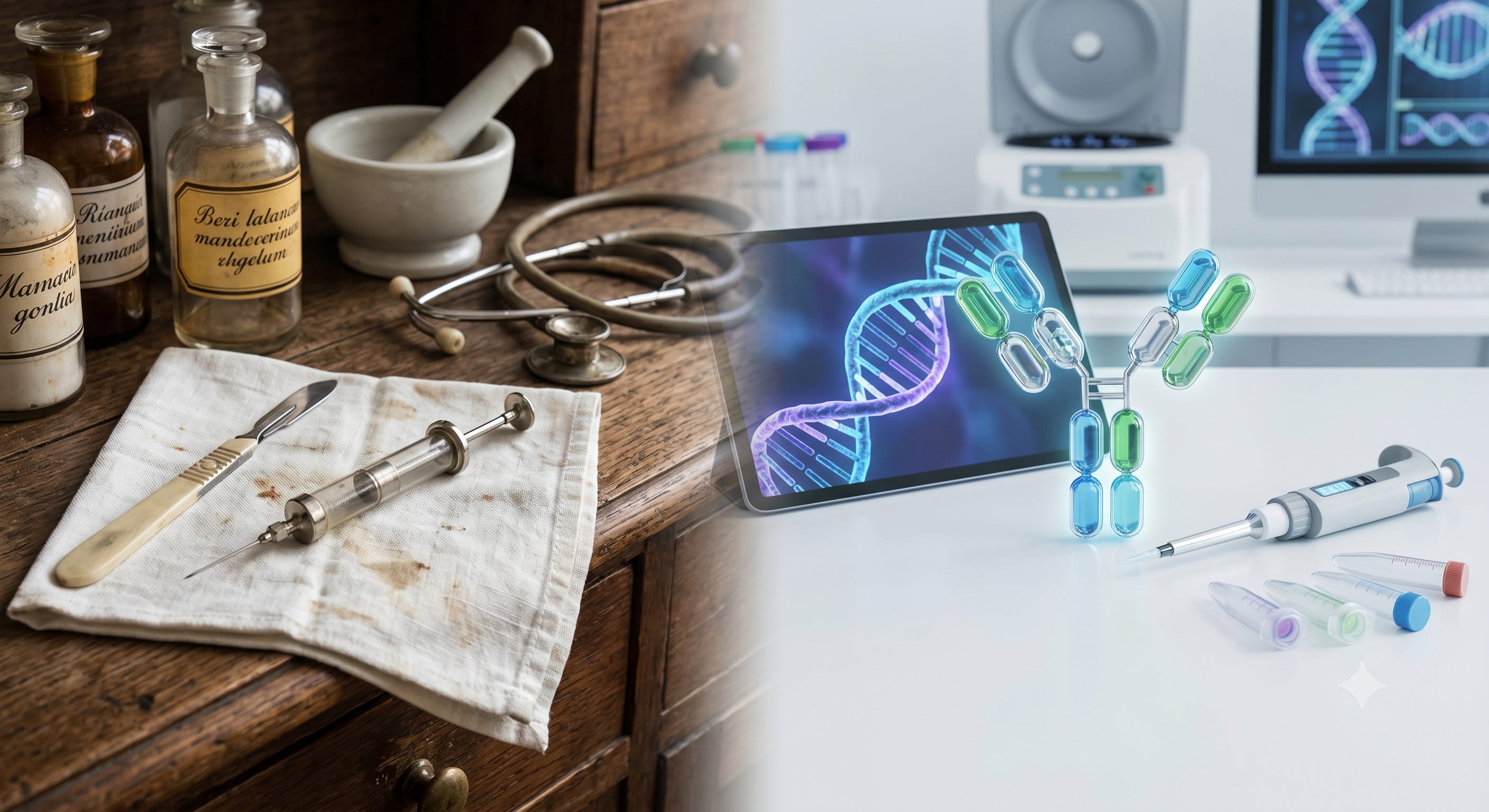
There is something philosophically cruel about cancer.
Most diseases make sense as enemies. A virus invades. A bacterium colonizes. A parasite takes up residence. The threat is foreign, and the immune system — that extraordinary, ancient system your body spent hundreds of millions of years developing — knows how to recognize foreign. It has antibodies and killer cells and inflammatory cascades designed to find the invader, mark it, and destroy it.
Cancer is not an invader. Cancer is you.
It is your own cells. Your own DNA. Your own biology, running the same programs it has always run, except that somewhere in the three-billion-letter instruction manual that governs every cell in your body, a single letter changed. Or a section got duplicated. Or a chromosome broke and reattached in the wrong place.
The immune system, for all its sophistication, was not built for this. It was built to recognize self and not-self. Cancer is self. It wears the same molecular name tag as every healthy cell in your body.
That is the fundamental problem. And it is why every treatment we have ever built for cancer — every surgery, every drug, every beam of radiation — has had to walk the same impossible line: destroy the thing that is killing the patient without destroying the patient in the process.
For most of human history, we were not very good at walking that line.
Cut It Out
The first serious attempt at treating cancer was surgery. You can see the tumor. You can reach it. You remove it. Problem solved.
Except it was not solved, and the surgeons of the nineteenth century could not figure out why. William Halsted, the father of modern surgical oncology, was one of the most technically gifted surgeons in American history. Operating at Johns Hopkins in the 1880s and 1890s, he developed the radical mastectomy — a procedure for breast cancer so aggressive it removed not just the breast but the underlying chest muscle and the lymph nodes in the armpit. The logic made sense. If cancer spreads by direct extension, remove everything it might possibly touch. Leave nothing behind.
The results were better than what came before. Local recurrence rates dropped. Some patients were cured. Halsted’s operation became the standard of care for breast cancer and remained so for nearly a century.
But patients kept dying anyway. Not from the breast. From somewhere else — the lungs, the liver, the bones. The operation had been radical enough to remove everything visible. It had not been radical enough to remove what was invisible.
What Halsted and his contemporaries did not yet understand — what the entire field of oncology would spend the next hundred years slowly working out — is that cancer does not wait for the surgeon. Long before a tumor grows large enough to see or feel, individual cells break free from it and enter the bloodstream. They travel. They settle. They wait, sometimes for years, in distant tissues where no scalpel can find them. By the time a patient walks into the operating room, the disease may already be somewhere the operation cannot reach.
Surgery is still essential. It remains the most effective treatment we have for solid tumors that have not spread. But a surgery that removes the primary tumor is only a cure if the cancer had not already sent scouts ahead — and there is almost no way to know, at the time of the operation, whether it had.
Burn It
Radiation emerged in the early twentieth century, not long after Wilhelm Röntgen discovered X-rays in 1895 and Marie Curie began mapping the properties of radioactive elements. By the 1920s, physicians were aiming beams of ionizing radiation at tumors and watching them shrink.
The mechanism is different from surgery but the principle is similar — destroy the cancer cells. Radiation works by damaging DNA. When a cell’s DNA is damaged beyond repair, the cell cannot divide. It dies. Tumors, which are made of cells dividing uncontrollably, are particularly vulnerable because rapidly dividing cells are more susceptible to radiation damage than stable ones.
Radiation is more precise than surgery in one sense — it can reach tumors that a scalpel cannot, wrapped around blood vessels or lodged in places where an operation would be too dangerous. It can be aimed. The beam can be shaped. Modern radiotherapy is a feat of engineering, delivering doses calculated to the millimeter across dozens of treatment sessions.
But it is still fundamentally a local treatment. It damages what is in the beam. It does not know about the cells that already left. And the beam, no matter how precisely aimed, does not discriminate perfectly between tumor and healthy tissue. The bowel wall adjacent to a colon tumor absorbs radiation too. The salivary glands near a throat cancer catch the edge of the beam. Fatigue. Burning. Long-term tissue damage. The side effects of radiation are the side effects of asking high-energy particles to do a precise job in a very imprecise biological environment.
Still. Tumors shrink. Patients survive who would not have survived otherwise. Radiation saved lives and continues to save lives. But it solved only part of the problem — the visible, localized, reachable part.
Poison It
The discovery of chemotherapy is one of medicine’s stranger origin stories.
Sidney Farber was a pathologist at Boston Children’s Hospital in the late 1940s, working with children dying of acute leukemia. There was nothing to offer them. The disease moved fast — weeks from diagnosis to death in most cases — and medicine had no answer. Farber was not an oncologist. He was a man who looked at cells under a microscope for a living, and he had a theory that the field largely dismissed.
He had noticed that folic acid, a B vitamin essential for cell division, seemed to accelerate leukemia growth in some of his patients. The logic that followed was simple and counterintuitive: if folic acid feeds the cancer, block it. Starve the cells of something they need to divide.
He tested an antifolate compound — a molecule designed to jam the folic acid pathway — in sixteen children with acute leukemia in 1947. Ten of them went into remission.
The medical establishment was not celebratory. Remissions were temporary. The children relapsed. And the idea that you could treat cancer with a chemical felt to many physicians like something between desperation and quackery. Farber was not deterred. What he had shown — quietly, in a children’s hospital in Boston, in a population everyone had already written off — was that you could interfere with cancer cell metabolism systemically and get a measurable response. That the disease was not beyond the reach of chemistry.
That observation became the entire field of chemotherapy. Methotrexate, the direct descendant of Farber’s antifolate, is still prescribed today. The platinum compounds, the taxanes, the anthracyclines that followed over the next five decades — all of them variations on the same foundational idea Farber proved out in those sixteen children.
The problem is that folic acid is not unique to cancer cells. Every rapidly dividing cell in the body needs it. Block the pathway systemically and you hit the leukemia. You also hit the gut lining, the bone marrow, the hair follicles. The cancer does not have a monopoly on the thing you are trying to take away.
Farber knew this. Every chemist and oncologist who came after him knew this. The entire history of chemotherapy drug development is, in one sense, the story of trying to solve a problem that Farber’s original experiment made visible in 1947 — how do you hit the cancer without hitting everything else?
Seventy years later, we are still working on it.
The Guess
Adjuvant chemotherapy is chemotherapy given after surgery to a patient whose tumor has been removed. The surgeon believes the margins are clear. The pathology report looks good. But the oncologist knows — from decades of population data — that a certain percentage of patients in this situation will recur. Cancer cells escaped before the surgery. They are somewhere in the body, too small to detect, waiting.
So the question becomes: do we treat this patient with chemotherapy?
And the honest answer, for most of oncology’s history, has been: we do not know.
We know the recurrence rate for a stage III colon cancer patient without adjuvant chemo is roughly forty to fifty percent. We know that adjuvant chemo reduces that rate meaningfully. So we treat everyone who fits the profile, because the math says enough of them will benefit to justify it at the population level.
But half of those patients — maybe more — were already cured by surgery. Their cancer had not sent scouts ahead, or the scouts had not survived. They did not need the chemotherapy. They would have been fine without it. And they went through six months of treatment anyway, because there was no way to know which half they were in.
There is nothing nefarious in this situation. It is the logical outcome of making decisions without information. And for a long time, the information simply did not exist.
That calculus is now beginning to change.
A Different Question
Precision medicine is not a product. It is a reorientation of the question.
Traditional medicine asks: what is the standard treatment for this disease in this population? Precision medicine asks: what is happening in this specific patient’s biology right now, and what does that tell us about what to do next?
The tools that make precision medicine possible are molecular. Genetic sequencing. Protein biomarkers. Imaging that reads metabolic activity rather than just anatomy. And, increasingly, the ability to detect fragments of DNA shed by tumors directly into the bloodstream — a technology called liquid biopsy.
The concept behind liquid biopsy is not as complicated as it seems. When cancer cells die — as all cells do, even cancer cells — they release fragments of their DNA into the blood. That DNA carries the same mutations that define the tumor. If you can find those fragments, sequence them, and identify the mutations, you have a window into the tumor’s biology without ever touching the tumor. A blood draw. A molecular snapshot of what the cancer is doing right now.
The challenge is sensitivity. At early stages, or after treatment when tumor burden is low, the amount of circulating tumor DNA — ctDNA — in a blood sample is vanishingly small. You might be looking for a handful of cancer-specific DNA fragments among billions of normal fragments. Finding that signal requires extraordinarily sensitive technology and, critically, knowing exactly what you are looking for.
That is where Natera comes in.